
Cité-des-Prairies Children's Prison
INSIDE CITÉ-DES-PRAIRIES: STAFF MISCONDUCT & CORRUPTION

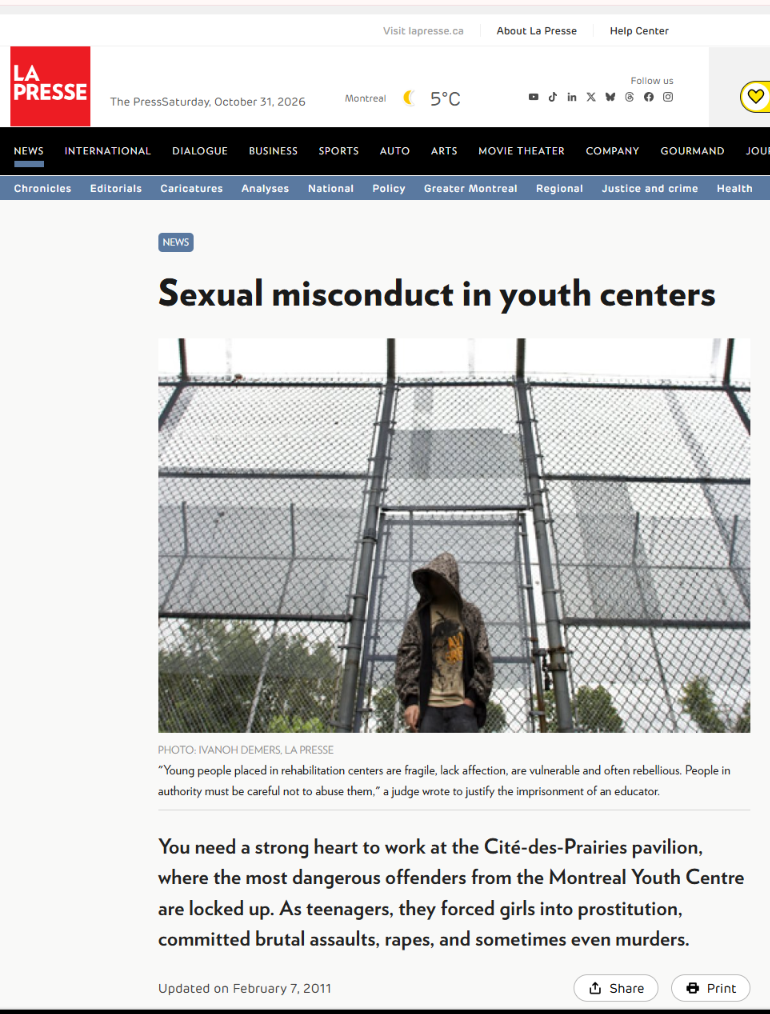
"Young people placed in rehabilitation centers are fragile, lack affection, are vulnerable and often rebellious. People in authority must be careful not to abuse them," a judge wrote to justify the imprisonment of an educator.
This doesn't stop some of the educators from falling in love with them. In 2007, one of these boys, a well-known member of a street gang, seduced a 21-year-old social worker. As soon as he was released, she resigned to go live with him.
His former colleagues are convinced their affair began within the unit, or during the young man's temporary leave. Some swear otherwise. In any case, the young woman—described as "a girl from a good family"—had a baby with the boy, who soon after ended up in prison.
That same year, history repeated itself. Another young educator from the unit. Another baby. Another street gang member, who now faces prison following a violent assault.
The two tough guys having already turned 18, their former caregivers, narrowly escaped prosecution for "sexual exploitation" of dependent minors. But this was only the beginning of the scandals in Cité-des-Prairies.
Since then, at least three or four other female educators have been questioned by police. Young offenders boasted about having lured them into their beds or caught them touching their roommates—most of whom were still minors. Approximately 60 educators work at Cité-des-Prairies. This means that one in ten has been caught up in a shady situation.
How can this be explained? "With a 20 or 21-year-old educator sponsoring young offenders of practically the same age, it's possible that, nature being what it is, they fall under their spell," replies Géhane Kamel, coordinator of labor relations in safety and working conditions at the Montreal Youth Center.
"This happens a lot in Cité-des-Prairies, because our guys aren't there for nothing. They are good manipulators and good charmers," she points out.
"We're talking about handsome guys with beautiful bodies, who know exactly what women want to hear," confirms one of their colleagues. "They make them feel unique in the world."
Franca Cortoni, a criminologist specializing in female sexual delinquency, agrees. "When the young person and the educator are almost the same age, one can wonder which of the two is exploiting the other. Some young women are naive," says this professor from the University of Montreal.
Too Young to Die
Children under Youth Protection deprived of their liberty
Isolation, locked confinement and children's rights
INSIDE CITÉ-DES-PRAIRIES: THE 2024 GOVERNMENT INVESTIGATION
There are approximately 150 male youths living in Cité-des-Prairies at any given time.
Seven of the facility’s 13 units — five high-security and two low-security — hold youths convicted or awaiting trial in crimes committed between the ages of 12 to 17, though they can be as old as 25, since they must then serve out their sentences.
The other six units are for youth protection, to help young people who have suffered abuse or have behavioral problems but have not committed a crime. (Female minors are held in other facilities.)
MY QUESTION:
Why are children under Youth Protection being locked up? Why aren’t they being cared for in a home-like setting instead of a children’s prison?
Young people at the Cité-des-Prairies centre are partially or completely deprived of their liberty following placements, either under child protection legislation or through the youth criminal justice system after committing offences.
In addition to attending school throughout the year, they are also encouraged to develop their social skills through clinical activities. This medieval day provided an opportunity to put these values into practice.
But what about counselling? These children are deprived of their liberty, supposedly for their protection, yet they do not receive counselling through the very institution responsible for their care.
The Blueprint: These units are designed as windowless concrete isolation boxes, containing bare metal bed frames and heavy doors bolted securely from the corridor.
The Structural Shift: Human rights monitors discovered that these cells were being grouped into dedicated “bloc-retrait” wings. Instead of utilizing isolation as a temporary, emergency safety intervention, the facility increasingly relied on it as an administrative tool to patch over structural staffing deficits.
The Reality of Care: Rather than receiving the clinical rehabilitation officially promised, youth placed in these sectors were completely cut off from basic educational services and human contact. No specialized educators were stationed inside the block; the teenagers were left under the distant, remote surveillance of security guards watching video feeds on closed-circuit television monitors.
Under Section 10 of the Quebec Youth Protection Act, the law states that restrictive measures—specifically isolation—may never be used as disciplinary measures or punishments.
The Cité-des-Prairies Rehabilitation Centre for Youths Experiencing Difficulties (Cité-des-Prairies) is a residential facility providing rehabilitation services for adolescent boys placed under the Youth Protection Act as well as the Youth Criminal Justice Act.
The saddest part of all this is that these children have already experienced childhood trauma. There have been countless studies examining where children who grow up in institutions and the Youth Protection system end up later in life.
Instead of receiving the care, counselling and support they desperately need, too many are being prepared for a future behind bars.
We are not rehabilitating these children. We are grooming them for the adult prison system.